Monday, July 23, 2007

Bharathi

Got this from a friend. He said Bharathi hit him so hard that it pained. Me too.
Donno which collection of songs this poem comes in.

தேடி சோறு தினம் தின்று
பல சின்னஞ்சிறு கதைகள் பேசி
வாடி துன்பம் மிக உழன்று
பிறர் வாட பல செய்கை செய்து
நரை கூடி கிழப்பருவம் எய்தி
கொடும் கூற்றுக்கிறையாகி மாயும்
சில வேடிக்கை மனிதரை போலவே
நானும் வீழ்வேன் என்று நினைத்தாயோ?

- மகாகவி சுப்ரமணிய பாரதி

To seek my morsels to eat daily
To mouth many a small quibble
To lose peace; to feel grief
To act and cause many around to ache
To grey in hair and attain old age
To fall prey to horrible Death and depart
Like many a laughable man on this earth
Did You think I too would fall like that ?

- Subramanya Bharathi

P.S. Excuse the translation.

Sunday, July 22, 2007

Work

When I see people feeling guilty for having had the simple joys of life (e.g. sleeping 6 hrs a night / watching a movie on a weekend), it makes you think. Glorification of this as ownership of the project at the workplace is unfair and stupid. Happiness shall never be mortgaged for responsibility.

Monday, June 04, 2007

Kolkata

My colleague Srinivas commented as we walked out of a building and a wave of Kolkata weather hit us, "Its like a wet furnace". Couldnt agree more.

Musings on Gita

After much reading and listening about the Gita, thought I had got atleast the basic idea of Krishna's epic advice to Arjuna.

Recently, after reading the book "Encounter the Enlightened", a collation of speeches by Sadhguru Jaggi Vasudev, felt the discourse of Krishna taking a new meaning.

The passage in question:

Question: Yes, I have a doubt. In the battle of Kurukshetra, why did Lord Krishna compel Arjuna, who had laid down his arms? He did not want to fight his own kith and kin, why did he compel him to fight?


Jaggi:
...Even on the battlefield, he was willing to slaughter almost everyone.
It was only five or six people - his grandfather, his Guru, his brother, his friend - except for them, he was willing to slaughter everyone else.
In truth, Arjuna had not given up violence. He only wanted to save these few people; He was willing to kill the rest. So that's why His teaching is like that.
I want you to understand what importance Krishna gives to one man's realization.
If you realize and in the process, ten thousand people die, it is okay; it is of so much value to the world.
It is that value that he is establishing.

Source: Encounter the enlightened-Conversations with the Master

Agreed the speech makes little sense without the context of what Jaggi's Isha Foundation is doing. More at ishafoundation.org. But have to think aloud lest this sinks into oblivion to the bottom of the muddy pond that my mind now is.

The trite phrase that invariable pops up in many a spiritual text / discourse is "to free oneself from action". Nice to hear. But that makes no sense since one's existence (including actions of self and others) is invariably experienced only through the mind driven by the five senses of the body.

Jaggi Vasudev's intent is to make a person explore the inner self and reach a natural state where the person does not identify oneself with actions/situations/one's mind. Confessedly an experiential feeling, little is forthcoming on this natural state from either Jaggi / Isha volunteers about what this is. I am willing to buy that stand since I have neither the inclination or the time to read about the quality of experiences (natural or otherwise) in another chappie's life communicated to me through the questionable medium of my mind and a more questionable medium of the English language.

Now as I understand that Jaggi imputes, Krishna was egging Arjuna to take the route to this natural state at the cost of a bloody war. The value given to one man's realisation is of note here, considering that those that did have changed the course of history (E.g. Christ, Buddha, Shankaracharya... etc.)

Recommended reading: Encounter the Enlightened - Conversations with the Master (Sadhguru Jaggi Vasudev)
This book and Jaggi Vasudev make more sense to me than any of the other literature of this nature I have ever read.

Monday, May 28, 2007

Beautiful language

Telugu is a language of very cute sounding verbs !

Thursday, April 19, 2007

A director's perspective

ஏதாவது ஒரு வகையில் நாம் எல்லோருமே மன நலம் பாதிக்கப்பட்டவர்கள் தான்
- இயக்குநர் பாலா.


'One way or the other, all of us are mental patients.'
- Bala, Film Director

Excuse the translation.

Friday, April 06, 2007

Reflection

The biggest examples of illogicality in this world lie in reasons that men give themselves when they make life's choices.

Saturday, March 03, 2007

The Firm

Saturdays and Sundays are when the real work gets done.

Thursday, March 01, 2007

Beautiful prose

Loved this prose from an acquaintance's blog:

"Gradually the threads dissolve, the strings come undone. We become footnotes in someone else's life, remembered fondly in the middle of drying dishes on a warm Wednesday night. In the end, this is all we're reduced to, this is what we're left with."

(Source:Sine-Qua-Non)

PC and his Quotes

Mr. Speaker, Sir,

182. One of India's proudest sons, Dr Amartya Sen, argues in his book "Development as Freedom" that development is a process of expanding the real freedoms that people enjoy. He says, "Growth of GNP or of individual incomes can, of course, be very important as means to expanding the freedoms enjoyed by the members of the society. But freedoms depend also on other determinants, such as social and economic arrangements (for example, facilities for education and health care) as well as political and civil rights." The UPA Government accepts this ethical dimension to the discussion of economic issues, and in this Budget I have attempted to reflect that dimension. More or less the same idea was articulated two thousand years ago by Saint Tiruvalluvar who said:

"Pini Inmai Selvam Vilaivu Inbam Emam

Ani Enba Nattirkku Iv Iyndhu"

(Health, wealth, produce, the happiness that is the result, and security

These five, the learned say, are the ornaments of a polity)

I am aware of the severe difficulties faced by farmers in the last two years. Ours is a compassionate Government. I also have severe fiscal constraints. When faced with a dilemma, I usually turn to my favourite poet-philosopher, Saint Tiruvalluvar. Writing over 2,000 years ago, he said:

"Karumam Sidhaiyamal Kannoda Vallarku

Urimai Udaithu Iv Ulagu"

(The world is his who does his job

With compassion)

Mr. Speaker, Sir, I have devoted the last 15 minutes or so to agriculture. There is no dearth of schemes; there is no dearth of funds. What needs to be done is to deliver the intended outcomes. Saint Tiruvalluvar watches over us and warns:-

"Uzhavinar Kai Madangin Illai Vizhaivathoom

Vittame Enbarkum Nilai"

[ If ploughmen keep their hands folded

Even sages claiming renunciation cannot find salvation]


Tuesday, November 21, 2006

The Man in the Car

Driving from Gurgaon to Delhi gives scope for a lot of reflection. On a bike, one gets to drive through a maze of cars stuck in traffic. In the morning you can find a variety of people going to office. Men of all kinds: the worried and impatient young executive in his worn out Alto, the suave and well dressed senior manager/CEO in the backseat of his corolla reading the ET. Nondescript analyst-consultant types like me on the TVS Victors and the like.

Basic point of the post is: life is not looking great. If ALL goes well (and God knows what all it will take), I would still at the end of it all be the Man in the Car, nothing more nothing less.

Wednesday, November 01, 2006

I have a dream

I have a dream of a world where the poor and deprived take full benefits of ICT in receiving basic services like health and education. a world where the poor and deprived feel empowered to demand accountability and make the democracy participatory and more meaningful.

And the private sector has to wrest the monopoly of the Government in provision of basic public services while accepting all norms of accountability that the Government operates under.

S Gokulakrishnan

Saturday, September 23, 2006

Quote on War

Quote

War is an ugly thing, but not the ugliest of things. The decayed and degraded state of moral and patriotic feeling which thinks that nothing is worth war is much worse. The person who has nothing for which he is willing to fight, nothing which is more important than his own personal safety, is a miserable creature and has no chance of being free unless made and kept so by the exertions of better men than himself.

John Stuart Mill

Saturday, September 09, 2006

Big brother

Some observations on the psyche of government officials.

Seniority within the organisation is no indication of leadership or personal qualities. One could be promoted to the very top while striving to cover one's a** all the time.

Personal commitment or volition to any task could be unheard of.

The biggest threat that can emanate from the lips of an official (at which they expect the listener to cower and run is "I can write a note on this to the department..."). Situations where this fails to frighten the listener completely flummoxes them.

At times, they fall into the habit of referring responsibility to a primordial omnipotent entity called 'Government' in case they want to absolve themselves of the issue at hand.
(E.g. 'The Government will decide upon what to do...', or 'The Government will take this up...')
Sometimes they refer to it lovingly as if it were alive.

N.B. These are the defining characteristics of organization culture. There are always exceptions.

Friday, August 25, 2006

Misfired stir

How I wish the RTI would cover the committee meetings and decision making of political parties too ! They cannot be shrouded from public scrutiny and at the same time allowed to affect public lives in the way the latest OBC bill has done.
Why does the PMK and DMK get away with pushing the Govt. into non exclusion of the creamy layer. If there is a sound reason, I cannot see it.
Even though at the outset everyone agreed that the affirmative action of the GoI was misdirected, the media and the Youth for Equality(YFE) chose to harp on concepts like equality and merit in opposing the OBC bill rather than focus on the issue of beneficiaries which could have got them support from all of educated India who instead stood as on lookers viewing the protests as largely driven by self-interest.

Monday, August 21, 2006

Southbound

Had a refreshing trip down south. Visited Mumbai, Hyderabad, Coimbatore, Chennai and Kozhikode recently. Loved the drive from Coimbatore to Kozhikode and back. Kerala under rains is a beauty to look at. Not good for the poor roads though. The state of the checkpost at Kerala-TN border is pathetic. For godssake, there are people waiting for hours to pay tax if only you will let them... tax administration has to go a long way in becoming citizen friendly.

IIM Kozhikode is ossum. But cannot figure out what the Govt. seeks to achieve by isolating the student community from the city and society.

Trip had an unpleasant finish when I lost my wallet. Funny part in Coimbatore when sitting in a car park in a pensive mood and a palmist in sunglasses comes up and says "Palmist sir... hand reading paarkreengala ?" I replied "Nee ennanaa solrathu... enakkae theriyuthu neram seri illai.. !" ("What is there for you to say ? I know it, I am having a bad time")

Tuesday, July 25, 2006

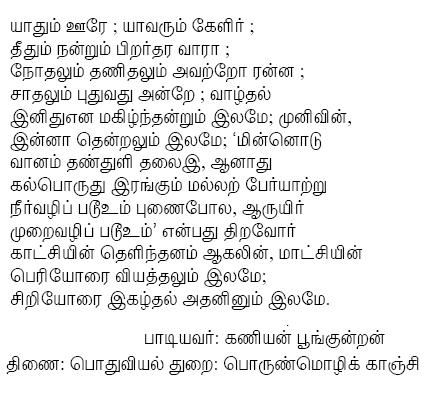
Revisiting old poem


This is a poem from an anthology(Purananooru) of 400 pieces on 'the exterior' or public life. A translation is given from here.

Every Town a Home Town
Every town our home town,
Every man a kinsman.

Good and evil do not come
from others.
Pain and relief of pain
come of themselves.
Dying is nothing new.
We do not rejoice
that life is sweet
nor in anger
call it bitter.

Our lives, however dear,
follow their own course,
rafts drifting
in the rapids of a great river
sounding and dashing over the rocks
after a downpour
from skies slashed by lightnings-

we know this
from the vision
of men who see.

So,
we are not amazed by the great,
and we do not scorn the little.

-- Kaniyan Punkunran

"Good and evil do not come from others. Pain and relief of pain come of themselves."
-- indicates emphasis on personal choice and belief in consequences
of personal decisions. Existentialism ?

"
Dying is nothing new. We do not rejoice that life is sweet nor in anger call it bitter."
-- okay...
"we are not amazed by the great, and we do not scorn the little."
-- moralistic, then its not nihilism.

Enigmatic little poem.

Saturday, July 22, 2006

N.B.

The penetrative mind of a well intentioned politician is worth more than all the gold in all the treasuries on earth.

random thought after last fortnight's news headlines.

Wednesday, July 12, 2006

Spirit of resilience(?) and Mr. Kasuri's audacity

Salaam Bombay. The way the city got its act together after the terrorist attack is inspiring. But however we may want to look at it, Mumbaikars spirit of resilience is basically driven by a need to get on with life since they cannot afford to do otherwise.

Mr. Kasuri's statement linking the Mumbai blasts and the Kashmir dispute sounds innocuously matter-of-fact, but it is far from ingenuous; not from him and definitely not at this juncture. Removing the diplomatic niceties, in political terms, it simply says 'see, if India wants this stopped, it has to come over to the negotiating table on Kashmir'. 'This kind of incidents can make India address things India doesnt want to address' This point is painfully close to the truth, but this hint from Mr. Kasuri on how to respond to a terrorist attack is closer to thuggery than the high office he holds.

Things like these cast dark clouds on otherwise well intentioned peace talks. India would not want to seem pressurised into peace talks, which will put the other side at an advantage in negotiations. But there are enough people within the Pakistani establishment to whom valid motives can be ascribed for overthrowing peace talks.

A more significant challenge would be to stop the stupidity of right wing extremist reaction to these incidents from within India itself. I wonder if the word 'Shiv Sainiks' has been coined cleverly to derive some divine legitimacy to their actions from the public. If it is Congress-'men' and DMK-'cadres' why not Shiv Sena-'members' ? Sainik is a revered word; not to be appropriated for lending legitimacy to right wing extremist purposes.

Thursday, July 06, 2006

On food, medicine and books

Is it right of a human deny aid to another's hunger, pain and illiteracy claiming the sufferer's inability to pay his profits as the reason?

In India, an entrepreneur can accumulate profits out of all the above three plagues on society. In advanced free market economies, one would expect the market to manage services in all the three, right ? But interestingly the strongest voice for free market, the US, has support programs which preclude undue profiteering in all the three sectors. Are we Indians missing the essence of 'free market'?

M. S. Swaminathan wrote about India "The growing privatisation of food and water security systems is already leading to an unequal social bargain. The poor will not be able to withstand the tragedy of distress sales and inundation by low-cost foods and fruits from rich countries whose agriculture is driven by heavy inputs of subsidy, capital, and technology." Ever wondered why US farmers dont commit suicides like these Indian farmers in AP and Vidharba. The Bengal famine of 1942 happened not due to grain shortage but because grains were locked up in private trader's godowns.

In healthcare in India, most medical supplies and equipments (even glucose drips) fetch margins of around 300% to the manufacturer. Why has the invisible hand failed to bring efficiencies ? seriously, I dont know.

Excellent public school systems are run by the government in fully capitalist economies to ensure basic education. All medical facilities are government funded by countries like US and Canada. One can walk out of hospitals after treatment without any other thought other than convalescence.

Let us not get this wrong. Excellent private run institutions exist in all three sectors in western countries. I wouldn't be surprised if the best facilities in these three sectors are privately run. But the government has ensured access to food security, healthcare and elementary education first.

Don't stupid, unemployable rural people get ill and feel hungry? Or are they stupid and unemployable because they fall ill and go hungry too often and are unable to improve their lot?