Thursday, September 20, 2007

How to name it?

When one has views that are very different from the surroundings, the misfit becomes very evident. Take for instance the case of a chap who has quit the firm but has to serve the notice period. Taking a step backwards from work (it could be a weekend break at home or a trip to Amritsar for instance), there is a moment of clarity when one realises where one's life is slowing leading to. As my friend from Kanpur would say "Arre bhai, main kounsi gali mein aa chuka hoon !". Fundamental questions about what motivated one to work in the first place start begging for answers. Definitely not money (that was a sitter, if you knew my payslip). Standing among peer-circle? Need for appreciation? 'kick' from working?

One feels awkward and there are the inevitable unpleasant situations in the initial stage, but later on there is only humor from the workplace. When colleagues try their old routine of well tested work instruments (read mental games, verbal jousts, pathetic pranks and other patented methodologies) on the person who has quit and fail to evoke the usual reaction, they are confounded by the impudence. Suddenly professional values are dusted off the shelf and quoted to bring the lost man to his senses. Meanwhile the person who has quit is in splits at the sight of the devil charging him of disregard to "values" and all copyrighted nice-to-own-up things (which are in a state of suspended animation for the still serving colleagues)

The only downside is that one cannot share the view with others so that they can also partake of the fun. It would be too crude to upset their feelings actually. (Also, it is in the firm's HR policy prohibiting one from encouraging others to quit when leaving.)

Havent mentioned the best part. The feeling of liberation and of living life on one's own terms. The feeling that limitations that held one back are only of the mind. And that everything in this world is for the taking if only because one's spirit wanted it. The belief that every wish other than those tainted with fear of failure shall be granted.

As Bharathi said
"No Fear, No Fear, There is no such thing as fear.
Even when the sky breaks and falls in pieces on your heads
Even when each and every single person on earth opposes you
Even when people look down upon and deride you
No Fear, No Fear, There is no such thing as fear"

Wednesday, September 12, 2007

Tuesday, September 04, 2007

Jedi Gurus


One of my favourite Starwars characters, Jedi Master Qui-Gon Jinn is a maverick Jedi Knight. His quotes remind one of teachings of Indian philosophy.

Some quotes from The Phantom Menace

Qui-Gon to Obi-Wan: Remember, concentrate on the moment. Feel, don't think. Use your instincts.

Qui-Gon to Obi-Wan: Don't center on your anxiety, Obi-Wan. Keep your concentration here and now, where it belongs.

More here on religious (or spiritual) themes in the Starwars series:

More quotes by Qui-Gon here.

Monday, July 23, 2007

Bharathi

Got this from a friend. He said Bharathi hit him so hard that it pained. Me too.
Donno which collection of songs this poem comes in.

தேடி சோறு தினம் தின்று
பல சின்னஞ்சிறு கதைகள் பேசி
வாடி துன்பம் மிக உழன்று
பிறர் வாட பல செய்கை செய்து
நரை கூடி கிழப்பருவம் எய்தி
கொடும் கூற்றுக்கிறையாகி மாயும்
சில வேடிக்கை மனிதரை போலவே
நானும் வீழ்வேன் என்று நினைத்தாயோ?

- மகாகவி சுப்ரமணிய பாரதி

To seek my morsels to eat daily
To mouth many a small quibble
To lose peace; to feel grief
To act and cause many around to ache
To grey in hair and attain old age
To fall prey to horrible Death and depart
Like many a laughable man on this earth
Did You think I too would fall like that ?

- Subramanya Bharathi

P.S. Excuse the translation.

Sunday, July 22, 2007

Work

When I see people feeling guilty for having had the simple joys of life (e.g. sleeping 6 hrs a night / watching a movie on a weekend), it makes you think. Glorification of this as ownership of the project at the workplace is unfair and stupid. Happiness shall never be mortgaged for responsibility.

Monday, June 04, 2007

Kolkata

My colleague Srinivas commented as we walked out of a building and a wave of Kolkata weather hit us, "Its like a wet furnace". Couldnt agree more.

Musings on Gita

After much reading and listening about the Gita, thought I had got atleast the basic idea of Krishna's epic advice to Arjuna.

Recently, after reading the book "Encounter the Enlightened", a collation of speeches by Sadhguru Jaggi Vasudev, felt the discourse of Krishna taking a new meaning.

The passage in question:

Question: Yes, I have a doubt. In the battle of Kurukshetra, why did Lord Krishna compel Arjuna, who had laid down his arms? He did not want to fight his own kith and kin, why did he compel him to fight?


Jaggi:
...Even on the battlefield, he was willing to slaughter almost everyone.
It was only five or six people - his grandfather, his Guru, his brother, his friend - except for them, he was willing to slaughter everyone else.
In truth, Arjuna had not given up violence. He only wanted to save these few people; He was willing to kill the rest. So that's why His teaching is like that.
I want you to understand what importance Krishna gives to one man's realization.
If you realize and in the process, ten thousand people die, it is okay; it is of so much value to the world.
It is that value that he is establishing.

Source: Encounter the enlightened-Conversations with the Master

Agreed the speech makes little sense without the context of what Jaggi's Isha Foundation is doing. More at ishafoundation.org. But have to think aloud lest this sinks into oblivion to the bottom of the muddy pond that my mind now is.

The trite phrase that invariable pops up in many a spiritual text / discourse is "to free oneself from action". Nice to hear. But that makes no sense since one's existence (including actions of self and others) is invariably experienced only through the mind driven by the five senses of the body.

Jaggi Vasudev's intent is to make a person explore the inner self and reach a natural state where the person does not identify oneself with actions/situations/one's mind. Confessedly an experiential feeling, little is forthcoming on this natural state from either Jaggi / Isha volunteers about what this is. I am willing to buy that stand since I have neither the inclination or the time to read about the quality of experiences (natural or otherwise) in another chappie's life communicated to me through the questionable medium of my mind and a more questionable medium of the English language.

Now as I understand that Jaggi imputes, Krishna was egging Arjuna to take the route to this natural state at the cost of a bloody war. The value given to one man's realisation is of note here, considering that those that did have changed the course of history (E.g. Christ, Buddha, Shankaracharya... etc.)

Recommended reading: Encounter the Enlightened - Conversations with the Master (Sadhguru Jaggi Vasudev)
This book and Jaggi Vasudev make more sense to me than any of the other literature of this nature I have ever read.

Monday, May 28, 2007

Beautiful language

Telugu is a language of very cute sounding verbs !

Thursday, April 19, 2007

A director's perspective

ஏதாவது ஒரு வகையில் நாம் எல்லோருமே மன நலம் பாதிக்கப்பட்டவர்கள் தான்
- இயக்குநர் பாலா.


'One way or the other, all of us are mental patients.'
- Bala, Film Director

Excuse the translation.

Friday, April 06, 2007

Reflection

The biggest examples of illogicality in this world lie in reasons that men give themselves when they make life's choices.

Saturday, March 03, 2007

The Firm

Saturdays and Sundays are when the real work gets done.

Thursday, March 01, 2007

Beautiful prose

Loved this prose from an acquaintance's blog:

"Gradually the threads dissolve, the strings come undone. We become footnotes in someone else's life, remembered fondly in the middle of drying dishes on a warm Wednesday night. In the end, this is all we're reduced to, this is what we're left with."

(Source:Sine-Qua-Non)

PC and his Quotes

Mr. Speaker, Sir,

182. One of India's proudest sons, Dr Amartya Sen, argues in his book "Development as Freedom" that development is a process of expanding the real freedoms that people enjoy. He says, "Growth of GNP or of individual incomes can, of course, be very important as means to expanding the freedoms enjoyed by the members of the society. But freedoms depend also on other determinants, such as social and economic arrangements (for example, facilities for education and health care) as well as political and civil rights." The UPA Government accepts this ethical dimension to the discussion of economic issues, and in this Budget I have attempted to reflect that dimension. More or less the same idea was articulated two thousand years ago by Saint Tiruvalluvar who said:

"Pini Inmai Selvam Vilaivu Inbam Emam

Ani Enba Nattirkku Iv Iyndhu"

(Health, wealth, produce, the happiness that is the result, and security

These five, the learned say, are the ornaments of a polity)

I am aware of the severe difficulties faced by farmers in the last two years. Ours is a compassionate Government. I also have severe fiscal constraints. When faced with a dilemma, I usually turn to my favourite poet-philosopher, Saint Tiruvalluvar. Writing over 2,000 years ago, he said:

"Karumam Sidhaiyamal Kannoda Vallarku

Urimai Udaithu Iv Ulagu"

(The world is his who does his job

With compassion)

Mr. Speaker, Sir, I have devoted the last 15 minutes or so to agriculture. There is no dearth of schemes; there is no dearth of funds. What needs to be done is to deliver the intended outcomes. Saint Tiruvalluvar watches over us and warns:-

"Uzhavinar Kai Madangin Illai Vizhaivathoom

Vittame Enbarkum Nilai"

[ If ploughmen keep their hands folded

Even sages claiming renunciation cannot find salvation]


Tuesday, November 21, 2006

The Man in the Car

Driving from Gurgaon to Delhi gives scope for a lot of reflection. On a bike, one gets to drive through a maze of cars stuck in traffic. In the morning you can find a variety of people going to office. Men of all kinds: the worried and impatient young executive in his worn out Alto, the suave and well dressed senior manager/CEO in the backseat of his corolla reading the ET. Nondescript analyst-consultant types like me on the TVS Victors and the like.

Basic point of the post is: life is not looking great. If ALL goes well (and God knows what all it will take), I would still at the end of it all be the Man in the Car, nothing more nothing less.

Wednesday, November 01, 2006

I have a dream

I have a dream of a world where the poor and deprived take full benefits of ICT in receiving basic services like health and education. a world where the poor and deprived feel empowered to demand accountability and make the democracy participatory and more meaningful.

And the private sector has to wrest the monopoly of the Government in provision of basic public services while accepting all norms of accountability that the Government operates under.

S Gokulakrishnan

Saturday, September 23, 2006

Quote on War

Quote

War is an ugly thing, but not the ugliest of things. The decayed and degraded state of moral and patriotic feeling which thinks that nothing is worth war is much worse. The person who has nothing for which he is willing to fight, nothing which is more important than his own personal safety, is a miserable creature and has no chance of being free unless made and kept so by the exertions of better men than himself.

John Stuart Mill

Saturday, September 09, 2006

Big brother

Some observations on the psyche of government officials.

Seniority within the organisation is no indication of leadership or personal qualities. One could be promoted to the very top while striving to cover one's a** all the time.

Personal commitment or volition to any task could be unheard of.

The biggest threat that can emanate from the lips of an official (at which they expect the listener to cower and run is "I can write a note on this to the department..."). Situations where this fails to frighten the listener completely flummoxes them.

At times, they fall into the habit of referring responsibility to a primordial omnipotent entity called 'Government' in case they want to absolve themselves of the issue at hand.
(E.g. 'The Government will decide upon what to do...', or 'The Government will take this up...')
Sometimes they refer to it lovingly as if it were alive.

N.B. These are the defining characteristics of organization culture. There are always exceptions.

Friday, August 25, 2006

Misfired stir

How I wish the RTI would cover the committee meetings and decision making of political parties too ! They cannot be shrouded from public scrutiny and at the same time allowed to affect public lives in the way the latest OBC bill has done.
Why does the PMK and DMK get away with pushing the Govt. into non exclusion of the creamy layer. If there is a sound reason, I cannot see it.
Even though at the outset everyone agreed that the affirmative action of the GoI was misdirected, the media and the Youth for Equality(YFE) chose to harp on concepts like equality and merit in opposing the OBC bill rather than focus on the issue of beneficiaries which could have got them support from all of educated India who instead stood as on lookers viewing the protests as largely driven by self-interest.

Monday, August 21, 2006

Southbound

Had a refreshing trip down south. Visited Mumbai, Hyderabad, Coimbatore, Chennai and Kozhikode recently. Loved the drive from Coimbatore to Kozhikode and back. Kerala under rains is a beauty to look at. Not good for the poor roads though. The state of the checkpost at Kerala-TN border is pathetic. For godssake, there are people waiting for hours to pay tax if only you will let them... tax administration has to go a long way in becoming citizen friendly.

IIM Kozhikode is ossum. But cannot figure out what the Govt. seeks to achieve by isolating the student community from the city and society.

Trip had an unpleasant finish when I lost my wallet. Funny part in Coimbatore when sitting in a car park in a pensive mood and a palmist in sunglasses comes up and says "Palmist sir... hand reading paarkreengala ?" I replied "Nee ennanaa solrathu... enakkae theriyuthu neram seri illai.. !" ("What is there for you to say ? I know it, I am having a bad time")

Tuesday, July 25, 2006

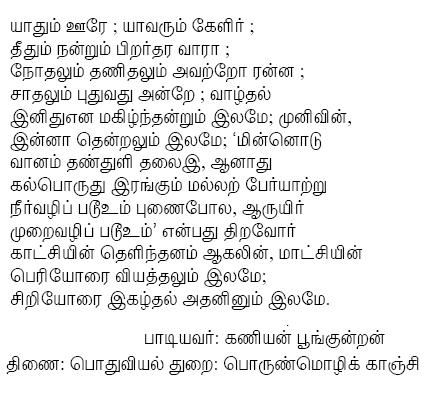
Revisiting old poem


This is a poem from an anthology(Purananooru) of 400 pieces on 'the exterior' or public life. A translation is given from here.

Every Town a Home Town
Every town our home town,
Every man a kinsman.

Good and evil do not come
from others.
Pain and relief of pain
come of themselves.
Dying is nothing new.
We do not rejoice
that life is sweet
nor in anger
call it bitter.

Our lives, however dear,
follow their own course,
rafts drifting
in the rapids of a great river
sounding and dashing over the rocks
after a downpour
from skies slashed by lightnings-

we know this
from the vision
of men who see.

So,
we are not amazed by the great,
and we do not scorn the little.

-- Kaniyan Punkunran

"Good and evil do not come from others. Pain and relief of pain come of themselves."
-- indicates emphasis on personal choice and belief in consequences
of personal decisions. Existentialism ?

"
Dying is nothing new. We do not rejoice that life is sweet nor in anger call it bitter."
-- okay...
"we are not amazed by the great, and we do not scorn the little."
-- moralistic, then its not nihilism.

Enigmatic little poem.