Saturday, June 03, 2006
Homebase
"It was a wonderfully fine thing to have that lofty castle to myself, and to feel, when I shut my outer door, like Robinson Crusoe, when he had got into his fortification, and pulled his ladder up after him. It was a wonderfully fine thing to walk about town with the key of my house in my pocket, and to know that I could ask any fellow to come home, and make quite sure of its being inconvenient to nobody, if it were not so to me. "
- Charles Dickens
Not having an address is a weird problem. Staying in company guesthouses here and there is convenient: homely food, laundry, A/c and all that but one is nevertheless bugged by that fact... All billings are to be done to my official address, cell cos have taken me off their network since I cant give them a verifiable address and one never knows where one's next base is going to be.
Despite all problems which are attendant on running an own establishment and even though I may not be using that place to a large extent, I prefer to have a homebase where all the bills come and where friends can be welcomed at ease.
N.B. homebase is not a word yet... but its nice.
Sunday, May 28, 2006
Fanaa
Monday, May 22, 2006
A word and a song...
The song I was listening to was from the Tamil movie Nanda and starts off 'Kalliyadi kalli...'
A rough translation of a section of it is as follows:
"Consider that there is no sea in between us....
the nations are the same...
Tamils are Tamils everywhere..."
Was kind of surprised that such a bold avowal was let off easily by the authorities though it was a movie on Sri Lankan refugees. It sounded like a cheap shot using identity politics rather than a mature artistic approach to the issue. Also, it is one of the modern day ambiguities in geopolitics but its strangely disturbing when popular art pushes such issues into public conscience. Have got used to issues like these handled by sensational newspapers and relegated to Page 5 International sections rather than listening to it as music.
Came across this word while going through some websites on Bahrain...
Irredentism : an international relations term that involves advocating annexation of territories administered by another state on the grounds of common ethnicity and/or prior historical possession, actual or alleged. It is a feature of identity politics and cultural and political geography.
... and that completed my circle of vapid thoughts.
Citizens or customers ?
Are people customers in a governmental setup ?
I instinctively say no to both the questions. Though student unions and e-government supporters can mention the word 'customer' in every sentence, my whole being revolts at that notion. What a horribly narrow minded view should one have to describe the relationship between a student and a teacher with a term which primarily means a person involved in a monetary exchange for goods/services offered. Similarly, can anyone buy good governance or the acumen of statesmen for the price paid as taxes? Amidst all the crap that is flying around since the current medico's strike, there was a surprisingly mature statement from the Arjun Singh when he said "we are concerned as the agitating students are our children too.." The veracity and intent can be questioned but that is not the point. That is the feeling of overarching responsibility and bonding that a Government should have with its people and that feeling towards the Government surpasses all monetary measures...
Sunday, May 14, 2006
Quote
Does the transience of all identities indicate that the Goal should be the transcend all identities?
N.B. abstained from examples in this case since examples seem restrictive rather than explanatory.
Wednesday, March 29, 2006
Of Singhs and Sikkimese
Friday, February 03, 2006
Memory dump:
(this after meeting seniors who come down here for PPTs and Chaos)
2) Thinking about
(a) companies to pick and why?
(b) companies not to pick and why ?
(c) running away from certain companies
(d) companies that will do (c) to me
(e) My own Company Inc.
3) Rang De Basanti
4) Mahabharata, Idealism vs. Reality
5) < Censored for explicit material >
6) Work for impending project deadlines
Thursday, January 19, 2006
Of Soundscapes and Melodies
Google defines
melody: specifically, the topmost line or voice
soundscape: an acoustic environment or an environment created by sound
Came across this interesting word called soundscape when reading a review of AR Rehman; the article said his music is influenced by that of Ennio Morricone (of The Good The Bad and The Ugly fame). This single word conveyed how the music of one relates to the other. One of those exquisite occasions when the medium transcends the message.
Listening to the two greats of Tamil music, Ilaiyaraja and ARR, one can immediately sense two different approaches to creating music. For me, Ilaiyaraja is the melody maker and Rehman, the soundscapist.
Both are just segments of a fulfulling musical piece... lyrics and vocalists being other important ones. But seems like the areas of specialisation of both musicians are different. With singers like SPB, Ilaiyaraja revelled in creating soulful tunes and melodies. ARR's focus is on creating a soundscape: choosing the base sounds for the song carefully. Running the risk of sampling bias, here are a few songs:
1) church bells tolling in 'Mukkaala, Mukkabula' - Kathalan
2) the barren effect and sounds in the song describing famine in 'Maari mazhai peyyatho' - Uzahavan.
3) more prominently, the rail tracks in 'Chaiyya chaiyya' - Dil Se
ARR uses brief vocal pieces for opening a song ('Chikku bukku', 'Maargazhi thingal', 'Mettupodu' etc) during which (and for a while after) he does the soundscape before launching into the main vocals.
'Sundari kannal oru' - Thalapathi
'Muthalvanae' - Muthalvan
Both are similarly situated songs of Ilaiyaraja and ARR respectively. Probably it's a misplaced comparison, but the difference between the two is too strong. The first one uses tunes and vocal improvisation of SPB to communicate the full pathos of personal life. In the second, ARR takes it upon himself to build the thick base of sounds to indicate conflict with personal life and leaves the rest of the job to Vairamuthu.
Imagine an artist labouring on a lake, a few trees, shrubs and a distant bird before painting the girl with a pitcher. Thats what ARR does to set the soundscape for a song. But with Ilaiyaraja, the image of the girl with the pitcher is so expressive that you don't have to be told where she stands.
Saturday, January 14, 2006
Music & Kites
1) Kannodu kanbethellam - Jeans
2) Soukiyamaa - Sangamam
3) Mettupodu Mettupodu - Duet
4) Maargazhi thingal - Sangamam
5) Ithuthaan Kathal - Puthiya Mugam
Warning: Overdose is injurious to your sense of reality
Uttarayan and Lohri as Pongal and Bhogi are called here respectively are on. Today went to Core House to meet Handaji and see the kite flying which is traditional here. From the terrace of the seven floor building I could see a million kites in the sky. Good sun, kite flying lessons, nice jalebis.
Tuesday, January 03, 2006
Don Quixote
Don Quixote is this stupid, well meaning, idealistic old gentleman who is drunk with visions of a chivalrous and honor-based society and sets out to be a knight-errant. Was it madness ? or was it another form of wisdom that declares war in defence of one's ideals ?
He fails miserably though and ends up in his deathbed as a chastened person. Even his squire Sancho is not a convert to his idealism. After becoming a reasonable man, he loses all his reasons to live. A critic refers to this as the world's betrayal of an idealist for the sake of materialism. No wonder, when the Cuban revolution ended, the first book printed and distributed by the Government was Don Quixote. They read a communist message in this book !
The question is: Why did Don Quixote end in a tragic failure ? will Quixotic fervor help in solving any problem facing society? Cervantes' greatness as an author lies in the fact that Don Quixote endears himself to the reader without once having to explain his ideals and despite all his foolish antics. This book reads like an appeal to that little bit of idealist in everyone to be Quixotic once a while.
Saturday, December 31, 2005
Thursday, December 22, 2005
Wednesday, December 21, 2005
Manjunath Incident
BPOs in Bangalore showed more character when the next day of the rape, they came together with a plan for increased security for their employees. There was a real threat to their business though hadnt they done this. But the response from the Indian industry to the Manjunath incident has been disheartening for fresh MBAs. Its not that some companies are untouched by corruption that they need not respond to this incident.
What next ? There are opinions about whistle blowers act which feel its not needed and what is needed are administrative reforms, not legislative ones.
As for the companies, could there be a realisation that ethical practices are more profitable in the long run and should be given a chance ?
Wednesday, November 23, 2005
Interesting Read
The term came to a close today. Probably for the first time in my life I am feeling blue about a course ending ! Got #$@%ed today in a group presentation. Was left wondering about motivations and reward mechanisms in general after that. A perpetual feeling of being chased by time and an urgency of goals is plaguing me (another lifetime first btw).
Sunday, November 13, 2005
Thursday, November 03, 2005
Arbit
Next time you see an excited man shouting "Eureka!", it could be just a naked madman who has no idea what a fool he is making of himself.
Monday, October 24, 2005
A Desert trip
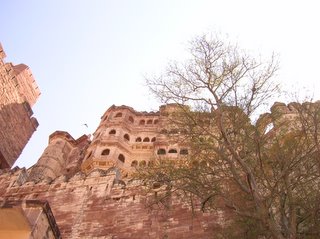
The practice of grafting has developed into an Art form. One could find auto wallahs, hoteliers, guides, restaurants, antique sellers, gift shops taking turns in extracting money from foreign tourists in various ways. But it was a small dilemma whether to intervene or not. Arent even airlines in India charge differential rates for foreign nationals ?
The magnificient palace of the Jodhpur Maharajah impressed me for all the wrong reasons. While the plaques and exhibits in the museum sing praises about his drought relief measures for the poor in 1930's, His Highness's concern for the poor didnt come out very strongly in the middle of the Officer's parties, hunting trips and flying clubs. BTW, the Maharaja's method of drought relief was to build a 350-room palace in sandstone providing employment to peasants in the process. Now thats what I would call truly multipurpose.
Rajasthan has breathtaking beauty in its historical monuments. The sand dunes in Jaisalmer are a sight to see. A picture I took of my friends there.
Saturday, September 24, 2005
Politics and Business
Watched an unusual movie called the Motorcycle diaries(2004). Unusual because of the narration and its being one of the few non-Hollywood foreign movies I have watched. Its a story about a young Argentinian Doc who along with his friend sets out on a trip across South America in his old Norton 500 motorcycle. The movie ends with a note that this guy later went on to become the famous leftist revolutionary Che Guevara. Disclaimer: Despite what a friend of mine used to insinuate in college, I do not hold communist views. Fact is I dont know what exactly communism stands for.
One interesting thing is that Che is not a celebrated or popular cult figure in India. I remember seeing one picture of him in a roadside youth club in Coimbatore once. But he is absent from our political scene; he is not revered or mentioned by any of the leftist parties in their political rallies or speeches.
During the trip, young Che is disturbed by the fact that economic interests which drove colonialism destroyed most of indigenous culture in Latin America. For instance, in Peru, he is stuck by the fact that the magnificient Inca civilisation was demolished to make way for the modern day Lima, simply because one of the warring sides had gun powder. Noam Chomsky tells us that the fate of native Indians in North America was not less cruel. The understanding is that economic interests driven by businesses widen the gap between the rich and powerful few and the deprived masses.
Seed of War: "Is there any man, is there any woman, let me say any child here that does not know that the seed of war in the modern world is industrial and commercial rivalry? -- Former American President Woodrow Wilson
“[T]he prosperity that companies like Microsoft now enjoy could not occur without having the strong military that we have.” -- Defense Secretary William Cohen
This blog is not the usual left vs. right debate that every one comes to hear about now and then. I was struck by the complicity of business interests in American politics and the National Security Council's plans to maintain this sphere of influence to protect American business interests. In fact, Noam Chomsky alleges in his book "What Uncle Sam really wants?" that America went to war with developing countries to prevent them from setting a good model of development without aiding American business interests. He calls this the Threat of a Good Example. Che Guevara's dream to create "one, two, many Vietnams" is interesting in the view of American policy makers' fear of a good model of development which did not involve American businessmen. But in reality, despite America's failure in Vietnam, the only example that Vietnam can now stand for is one of liberalisation and successful opening up to external trade. There could be a lot of debate on the rationale of America's military involvement in a lot of countries (explicit or CIA-backed) post WWII. The fact is that most of the American populace including the war veterans still do not understand the rationale of the Vietnam War or the Iraq War. Was there just an ideological intent of preventing Communism or was it a plan to prevent any Government from succeeding in meeting the people's needs without American investment and trade?
Even if we agree that the communist plan is really decadent and unsuitable that China itself has thrown it away, isnt the US model of business-driven foreign policy dangerous for the Third World ?
What the US is NOT doing:
1) Interfering in other countries to support the spread of democratic ideology.
The US supporting the Shah of Iran in a coup to overthrow the democratic government of Mossadeq.
2) Using its military power to prevent human rights violations across the world.
A list of US war crimes post WWII themselves qualify as human rights violations.
What is the US actually doing?
If we dont consider the business angle, the whole of US foreign policy will appear to be a series of mistakes and goof ups since 1945. But considering the benefits they have brought to the US business community, all of the US operations make tremendous sense. Be it the control of oil resources in the Persian Gulf or the liberalisation of African countries to act as sources of raw materials and markets for US corporations.
Where does India fit into all this?
Since we downplayed the socialist angle in our economics, probably we dint attract much of US attention. Though there are stories making rounds in the newspapers about Congress receiving support from the CIA in Kerala and West Bengal to keep the Communists in check.
Since 1991, the IMF-forced-liberalisation and reforms have opened up the Indian economy to foreign investment. The quality of services to the urban populace have definitely gone up. But have the really needy people, the "poorest of the poor" really benefited from economic reforms ? Or has the gap between the classes just gotten wider ? Through GATT and WTO, India is being forced to support IPR and product patents in pharmaceuticals. The current situation is that the Indian poor can afford a lot of medicines unlike our neighbour Pakistan because India has developed its own pharma industry where some companies have discovered cheaper ways of making drugs than their foreign counterparts. If in the future, the product patents come into practice, in the worst case, the cost of these drugs will go up and the Indian poor will die unable to afford costly drugs. This is barely the free trade that one is taught with ferverent zeal in Economics courses.
Is this an example of US arm-twisting a country into opening up avenues for its industry to set foot at the cost of real development for the poor and the defenceless? This is a very naive logic that has been discussed lots of times by economists everywhere but surprisingly I havent heard of a good counter logic in favour of the GATT reforms in pharma.
What about Indian politics ? The business lobby here is getting a stronger say in Government policies. The American model of lobbying and using the Government to push business interests might well be underway here too. The nexus between Politics, foreign policy and Business is gaining hold in India also. It cannot do much harm to other countries though considering the relatively weak position of India vis-a-vis the other economic powers. But with growth, the tendencies to exploit and make profits at the cost of weaker peoples/countries will turn into a very real threat to Indian policy makers.
Gokulakrishnan S
Wednesday, September 07, 2005
This is a blog I started writing some time back. Was waiting for some ideas to complete this and now I realise that is not going to happen soon.
Groups and Identity
Watched two Aamir Khan starrers recently. 1947- The Earth and Mangal Pandey. Don’t know why I suddenly wanted to watch two films linked to the Freedom struggle.
In the first one, young Mangal Pandey faces a dilemma about his identity, his religious one in a society where people could be excommunicated for using greased cartridges and another of an honorable soldier in the Company’s service. Then later the story goes into how the entire matter shifted from being about grease and rifles to something about honor and self respect.
In the second, a ice candy man suddenly sides with a mob of his religion to take revenge on a girl who refused to take him.
“Any trait, biological or cultural, can become an emblem of collective identity. Biological, linguistic, religious and political traits often are identified by the believers as denoting their distinctiveness.” - Caste, Nationalism and Ethnicity: Jacob Pandian.
1) Groups are very scared about losing their distinctiveness and hence try to preserve the group’s symbols fanatically.
2) Group members restrict entry to their group for the same reason.
There are so many powerful symbols of groups around us that it is no point trying to attack the groups. What it does to men’s behavior is of interest. Humanity’s greatest crimes happened when men formed groups which set out doing things against humanity (Cleansing a country of Jews, Seeking religious freedom through a new country etc).
What binds men together?
The fact that they both were born in the same geography?
Or because an official put down their names together in the same list when they joined any organisation?
Because the other spoke the same tongue as he did?
Why do men boo, ridicule and refuse to cooperate with each other?
The fact that both were born in different geographies?
The fact an official put down their names in different lists when they joined the organisation?
Because the other cannot speak his tongue?
"Mr. Pickwick and company found themselves in Eatanswill amidst a crowd which was either decidedly Blue or unquestionably Buff. After hurrahing along with the mob for Mr. Slumkey, Mr. Pickwick, in a low tone said, 'Hush. Don't ask any questions. It's always best on these occasions to do what the mob do.'
'But suppose there are two mobs?' suggested Mr. Snodgrass.
'Shout with the largest,' replied Mr. Pickwick.
Volumes could not have said more."
There is no saying what a mob will not do. Mobs are made up of people who identify themselves with a particular identity. I for instance can identify with a dozen things. I am a man, an Indian, speak Tamil, an engineer, student, Anna University alumnus, a blogger, from Section D, belonging to Dorm 21, LEMmer etc. Others I am sure can come up with a dozen more including identities of their place of work, residence etc.
Are there any non negotiable values that rise above all identities and loyalties a man is burdened with? My friend once told me there are no non negotiables in life. “Even sell one’s wife if need be” were his exact words. I don’t share his skepticism. Then how does this apple cart of society carry on without toppling? Maybe because of the fact that every group is faced with a counter group which ensures peace. When faced with a mob with a common feeling of revenge and intent of vandalism, there arise counter groups like the Army which have values such as courage and honor to keep in check another group from realizing objectives.
(not completed)
Gokulakrishnan S